
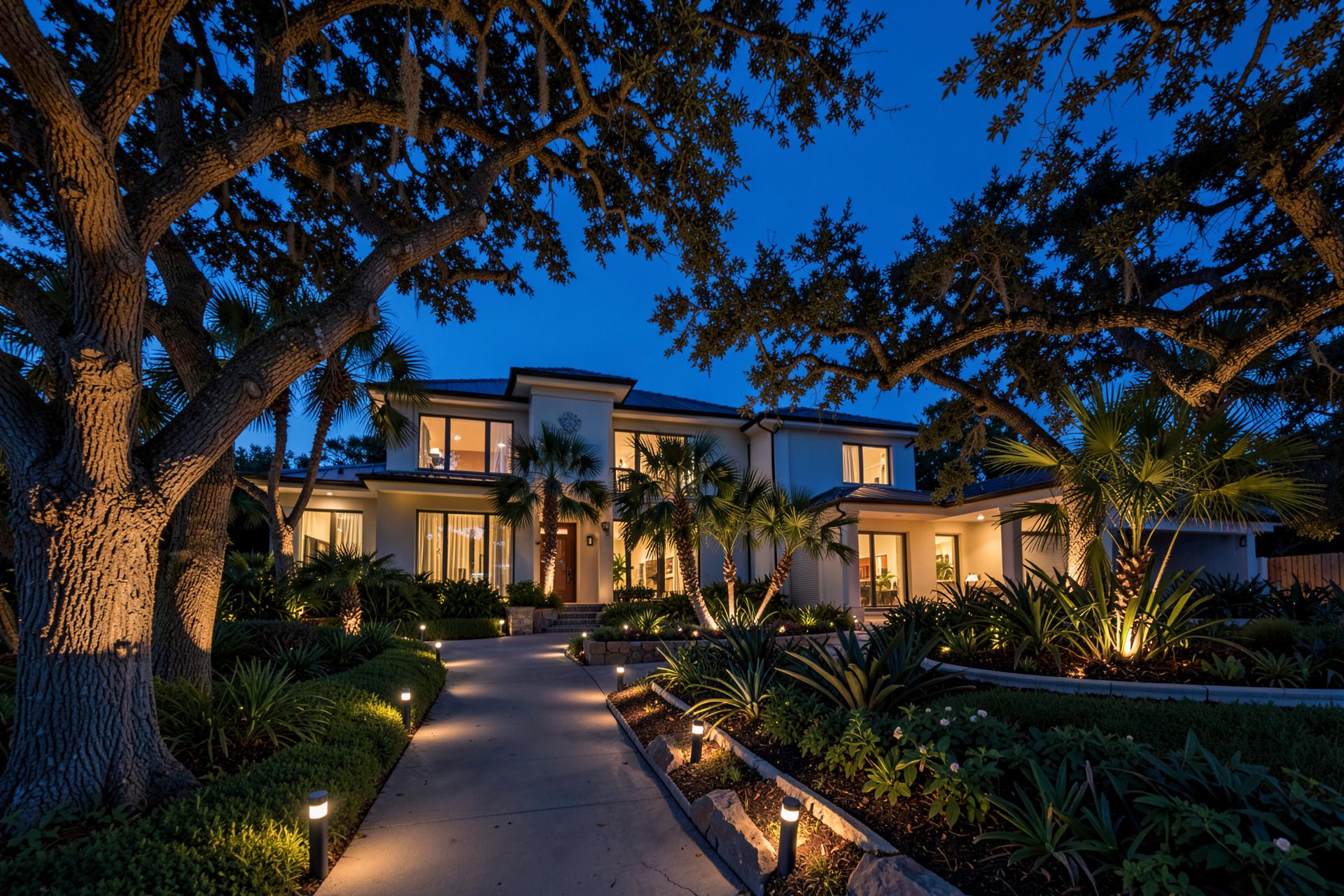
Landscape lighting pricing · Houston
What a Landscape Lighting System Costs
Fixtures are the visible part. The transformer, wire, connectors, controls, and installation are what make the system work — and they are all in the quote.
System diagram
What Drives Each Fixture Group
What drives installed cost
Pathway & driveway
- Fixture count follows walkway and drive length
- Concrete crossings and hard soil add labor
- Longer runs need heavier wire gauge
Cost per fixture is only useful alongside the transformer, wire, controls, and labor the system actually needs.
Cost factors
Six inputs behind every estimate.
Number of fixtures
The single largest driver of both material and installation time.
Fixture type & beam
Path lights, uplights, spots, hardscape, and wall lights differ in construction and output.
Transformer capacity
Sized to total load; larger systems may need a bigger unit or several.
Wire length & routing
Gauge, spacing, trenching, and hardscape crossings all add up.
Property conditions
Dense planting, retaining walls, hard soil, slopes, and tight side yards.
Controls & zoning
Timers, photocells, smart controls, and separate zones for larger properties.
Labor & installation
Priced on Complexity
- Fixture placement planned around each feature and beam effect
- Trenching and wire routing through beds, hardscape, and long runs
- Transformer location, mounting, and connection
- Weather-resistant connections at every fixture and zone
- Nighttime aiming to refine beam direction and balance
- Full system testing across fixtures, zones, load, and controls
Residential vs. commercial
Scale changes the plan.
Homes are usually one coordinated system across the front, beds, trees, and outdoor living areas. Commercial, HOA, and multi-zone properties add longer runs, more crew time, additional zoning, and coordination with property management.
New vs. upgrade
Two very different starting points.
| Element | New system | Existing system upgrade |
|---|---|---|
| Design | Complete property-wide plan | Plan built around what stays |
| Fixtures | All new professional-grade LED | Selective LED replacement |
| Transformer | Sized to the new load | Reused, resized, or replaced |
| Wiring | New runs and connections | Repairs where damaged or corroded |
| Zones | Planned from the start | Added as coverage expands |
| Controls | Included in the design | Often added as an upgrade |
Older or poorly designed systems are sometimes more practical to replace than to patch. We say which after an evaluation. Request a system evaluation.
How we build the quote
Property walk to written scope.
- 01
Property review
Pathways, trees, beds, architecture, patios, drives, and walls.
- 02
Fixture planning
Type and count for each area of the design.
- 03
Transformer sizing
Capacity for the total load, with room for planned growth.
- 04
Wiring & zone planning
Wire routes, connection points, zones, and control needs.
- 05
Installation complexity
Hardscape crossings, soil, access, and property obstacles.
- 06
Material & labor pricing
Fixtures, transformer, wire, controls, install, testing, adjustments.
- 07
Clear project scope
Approved areas, components, and price before installation begins.
FAQ
Landscape Lighting Pricing FAQs
Cost depends on the number and type of fixtures, transformer size, wire length and routing, property layout, installation conditions, and whether the project is residential or commercial.
Fixture count is a major factor, but the installed price also includes the transformer, wiring, connectors, controls, labor, testing, and nighttime adjustments. A per-fixture number alone can be misleading.
The transformer must be sized to the total system load. Larger systems may need a higher-capacity unit or multiple units.
Usually the wire runs are longer and the fixture count is higher, which increases both material and labor. Access conditions and landscape density also matter.
Often, yes — if the wiring and transformer are in good condition, older fixtures can be replaced with professional-grade LED options without rebuilding the system. Damaged wiring or an undersized transformer changes that.
Yes. Additional fixtures, zones, and areas can typically be added if transformer capacity, wiring, and controls allow.
Custom design, approved fixtures, transformer and power components, wiring and connectors, installation, timers or controls where included, testing, nighttime adjustments, and a final walkthrough.
Begin the design
Get a landscape lighting quote.
Tell us which areas you want lit. We'll design the system, size the components, and price the complete installation.