
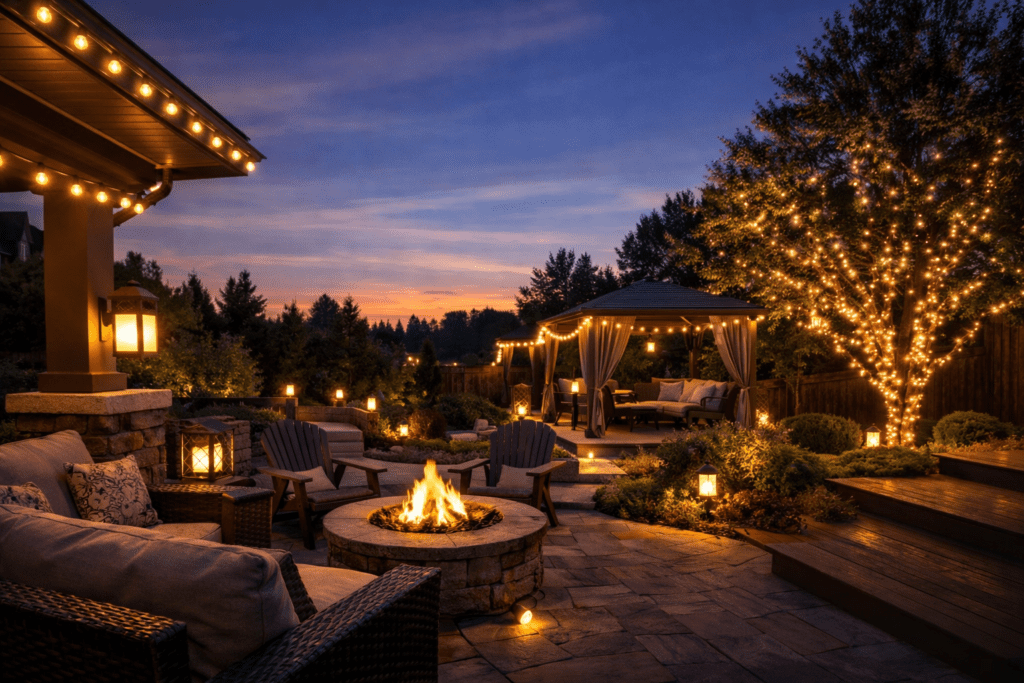
Permanent outdoor lighting is an essential part of how homes and commercial properties look, function, and feel after dark. A well-designed lighting system can improve safety and visibility, enhance architectural details, and improve outdoor living spaces.
But great outdoor lighting isn’t just about the fixtures you see. Behind every reliable, great-looking setup is a carefully planned system of mounts, wiring, power supplies, controls, and weatherproof outdoor lighting accessories working quietly in the background. Miss the details, and even the best lights can fall flat.
That’s where this guide comes in. We break down permanent outdoor lighting and the accessories that support it, how they work, how to choose them, and how to install and maintain them properly.
Key TakeawaysWhy Permanent Outdoor Lighting Is Essential Understanding Permanent Outdoor Lighting Systems Types of Permanent Outdoor Lights You Need to Know Essential Accessories for Permanent Outdoor Lighting Design Ideas & Practical Use Cases How to Pick the Right Outdoor Lighting Accessories Installation Made Easy: Steps & Essentials Maintenance, Repairs & Troubleshooting Cost Guide and Budget Planning |
Why Permanent Outdoor Lighting Matters?
Improves Security and Safety
Fixed outside lighting may go a long way in preventing incidents and ensuring safety. It ensures that the walkways, stairs, driveway, and entrances can be seen clearly at night, preventing chances of slipping and falling. It is also a good way to deter burglars and ensure the safety of the building.
Highlights Architecture and Landscaping
Another advantage that comes from these lights is the fresh look that you can give to your property. When you install the lights strategically, you can end up illuminating architectural elements such as columns, facades, and walls with texture, and even landscaping elements like the trees, gardens, and ponds.
It is possible to choose additional functional outdoor lighting accessories, for example, mounts, spike lights, and accent lighting, which allow precise direction of focus and beam, hence creating contrast and highlight features, thereby enhancing the aesthetic look of your home.
Offers Longevity and Reliability
Permanently installed light fixtures are much more robust when compared to their portable or temporary counterparts. These lights are designed to be weather-resistant, corrosion-resistant, and rugged enough to withstand wear and tear. Marine-grade Al alloy, SS, and weather-resistant plastics ensure the light’s structure does not degrade over the years under external conditions and weathering.
Offers Control and Operational Efficiency
The use of modern permanent lighting outdoors is accompanied by modern control systems that have increased both efficiency and effectiveness. Antennas, timers, dimmers, motion sensors, smart controls, and programmable circuits are some of the accompaniments of modern lighting systems, which help control lighting hours, intensity, as well as consumption rates effectively by ensuring that lighting is done when needed only.
Understanding Permanent Outdoor Lighting Systems
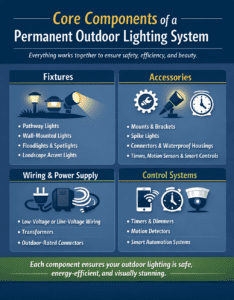
A permanent lighting system is described based on its durability, mounting, and functionality. It may include outdoor light accessories, fixtures, and other components that can withstand the elements, last longer, and be mounted in a way that blends with the surrounding architecture. Lighting systems may include wires, mounting, and control units installed in a way that is permanent.
How Permanent Lighting Systems Work
Permanent lighting systems can be designed either for low-voltage or line-voltage systems. Low-voltage systems, with 12V, are energy-efficient and can be easily handled. They are apt for use in landscape and pathway lighting. Line-voltage systems (120V) have greater power. They can be used for floodlighting and architectural lighting. Control devices, such as timers, sensors, and smart devices, are used to control the lighting, ensuring efficient functioning with effective utilization of light.
Common Installation Locations
Permanent outdoor lighting is installed in locations that optimize both safety and aesthetics:
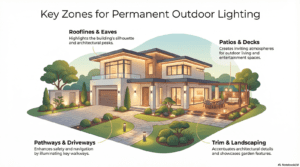
The careful combination of fixtures, accessories, and strategic placement ensures each outdoor area benefits from both functionality and beauty.
Types of Permanent Outdoor Lighting
Choosing the right fixture for outdoor endurance is crucial when selecting permanent lighting. Let’s talk about the most frequent types of permanent outdoor lights:
Network Lighting and Path/Bollard Lighting
Such light fittings are placed along sidewalks, driveways, and garden paths. Their intention is to offer low-level lighting. Such lighting is essential in increasing light in the evening while ensuring that the lighting effect is soft.
Wall-Mounted Outdoor Lights
Wall-mounted lighting is installed against exterior walls, entrances, and boundaries. These light sources offer constant illumination of entrances as well as the surrounding environment, and are aspects of safety and definition.
Floodlights
Flood lights are intended for wide area lighting. These are often designed with lighting yards, driveways, or perimeter lighting in mind and can handle higher-intensity lighting.
Spotlights & Uplights
Spotlights and uplights are perfect for lighting architectural and landscaping elements. Spotlights are meant for focusing the light on specific elements, while uplights shine the light upwards to add depth and dimension.
Step & Recessed Lights
Such lights, fixed on stairs, decks, and retaining walls, promote gentle illumination along with enhanced security. Elevation points include stairs in the yard.
Accessories That Support Permanent Lighting
Permanent outdoor lighting systems depend on residential and commercial outdoor lighting accessories as they support installation, power flow, control, and protection, so that the lighting system performs as intended in outdoor environments.
Mounting and Installation Hardware
- Brackets and mounting plates for walls, ceilings, and surfaces
- Ground stakes and in-ground mounts for landscape lighting
- Recessed housings for built-in applications
- Adjustable mounts for precise beam positioning
With proper mounting, there won’t be any issue of shifting, misalignment, or uneven illumination caused by wind, soil movement, or structural vibration.
Wiring and Electrical Connectors
- Outdoor-rated cables designed for moisture and temperature exposure
- Connectors that don’t let water in
- Insulated wiring to keep voltage from dropping and prevents other electrical faults
High-quality wiring reduces corrosion risks and ensures consistent system performance.
Transformers and Power Management
Power accessories regulate and distribute electricity safely.
- Low-voltage transformers for outdoor lighting systems
- Load-balancing components to maintain stable output
- Surge protection to safeguard fixtures
Control and Automation Accessories
These components improve efficiency and usability.
- Timers and photocells for automated operation
- Motion sensors for adaptive lighting
- Dimmers and smart controllers for controlling brightness
Protective and Weather-Resistant Components
These shield the systems from environmental damage.
- Weatherproof housings and gaskets
- Corrosion-resistant enclosures
- UV-resistant seals and covers
Extension and Customization Components
For system expansion and flexibility.
- Extension cables and splitters
- Modular connectors for future upgrades
Design Ideas & Practical Use Cases
- Layered Front Yard Design: Combine pathway lighting with focused entryway illumination. It creates a clear navigation and balanced visual structure across the front yard.
- Framed Entryway Lighting: Lighting should be distributed equally around doors and entryways. It will improve visibility for locks and steps while maintaining a symmetrical look.
- Continuous Pathway Layouts: Space lights equally along walkways and garden paths for a smooth visual flow and consistent nighttime visibility.
- Architectural Accent Designs: Focus on specific lighting techniques that highlight building facades, pillars, or textured surfaces. This is going to accentuate the building without emphasizing much on the surrounding environment.
- Outdoor Living Area Planning: Light your patios and decks with layouts that support seating, dining, and movement so that the space remains bright, comfortable, yet very functional.
- Subtle Perimeter Definition: Soft lighting along boundaries and less-visible zones helps maintain orientation and spatial clarity across the property.
Choosing the Right Accessories for Your Home
How to Select the Right Bulbs
Bulbs are one of the most important outdoor accessories for lights. So choose them wisely by considering: –
- Lumens: The brightness of the bulbs should go with the function of the space. Pathways and accent areas need controlled output, while driveways and open zones require higher lumen levels.
- Color Temperature: Warm lights go well with living areas. Neutral tones, on the other hand, improve clarity around entrances and steps.
- Lifespan and Heat Management: Opt for long-rated bulbs with proper heat dissipation as they last longer, offering consistent performance.
- Voltage Compatibility: Don’t forget to match bulbs to the system’s voltage to avoid premature failure.
Picking the Right Clips, Sockets, and Wires
- Compatibility: Ensure all connectors and wiring match the fixture type and electrical load.
- Durability and Weather Rating: Pick the components with outdoor-rated materials and appropriate IP ratings. This protects them against moisture, dust, and temperature changes.
- Installation Stability: Secure and solid mounting reduces movement, wear, and connection failures over time.
- Scalability: Accessories should allow future expansion without rewiring the entire system.
Power Accessories Buying Checklist
- Safe Voltage Levels: Match transformers and connectors precisely to system requirements.
- Load Capacity: Ensure accessories can handle the total electrical demand.
- Smart vs. Manual Controllers: Choose based on automation needs and usage patterns.
- Compliance and Accessibility: Look for certified components that allow easy maintenance and upgrades.
Installation Essentials
Pre-Installation Checklist
- Layout Planning: Plan fixture placement, spacing, and zones for walkways, patios, and architectural highlights
- Tools and Equipment Needed: Voltage tester, drill, wire strippers, tape measure, mounting hardware
- Component Verification: Check the compatibility of fixtures, wires, transformers, & connectors. Don’t forget to check the Outdoor Rating.
- Safety First: Turn off the power, use protection, and learn about local electrical regulations
- Environmental Considerations: IP rating and weatherproofing confirmed against exposure conditions
Step-by-Step Installation Process
- Measuring & Marking: Precisely mark fixture positions to maintain uniform spacing, optimal beam angles, and proper coverage, avoiding obstacles like plants or steps.
- Mounting Fixtures: Mount each fixture using the recommended mounting hardware supplied by the manufacturer or mounting brackets that prevent slippage or movement
- Wiring: Route cables neatly, avoiding tension points and sharp edges. Use outdoor-rated wiring and waterproof connectors. Secure wires with clips or conduits to prevent wear and simplify maintenance.
- Power Connection: Connect to transformers or main supply, confirming voltage compatibility and load capacity. Use breakers or fuses for safety.
- Testing: Energize the system gradually, one zone at a time, checking illumination, alignment, and coverage. Make adjustments before final commissioning.
Common Installation Pitfalls to Avoid
Overload above rated capacity: Operating above the transformer or circuit’s rated capacity can cause overheating, voltage drop, or component failure. Add up the wattage of all fixtures on a segment of a circuit and keep that total at or below the recommended wattage rating.
Using Incorrect Clips or Mounting Hardware: Improperly secured/mounted lighting fixtures are bound to shift with wind currents, vibrations, or movement of soil. Inefficient usage of lighting clips/mounting hardware may even result in unaligned lighting, strained wiring, and reduced life of lighting fixtures and connectors.
Poor Wire Management: Wires that are exposed, tangled, or not properly supported are more likely to get damaged, get wet, and wear out faster. This makes the system less reliable and could also be dangerous.
Maintenance, Repairs & Troubleshooting
Here are essential ways to maintain your outdoor lighting system:-
Routine Maintenance
- Cleaning: Clean fixtures, lenses, and housings to eliminate any dirt and dust that may inhibit light and efficiency.
- Moisture Checks: Inspect seals, gaskets, and connectors for water ingress. Replace damaged components promptly to prevent corrosion or electrical faults.
- Hardware Inspection: Ensure mounting brackets, clips, and screws remain secure and properly aligned.
Common Issues and Solutions
- Flickering Bulbs: Check voltage consistency and connections; replace bulbs if rated life has expired.
- Loose Connections: Tighten all wiring, clips, and connectors to restore stable operation.
- Water Infiltration: Reseal fixtures, replace faulty gaskets, and inspect wiring insulation for damage.
When to Replace Accessories
- Bulb Aging: Replace bulbs approaching end-of-life to maintain consistent brightness and color temperature.
- Wiring Wear: Swap out frayed or exposed wires to prevent shorts or hazards.
- Power Supply Failures: Replace transformers or controllers that show signs of overload, overheating, or inconsistent output.
Cost Guide and Budget Planning
| Accessory Type | Typical Price Range |
| Light Bulbs | $1 – $30 per bulb |
| Lighting Kits | $30 – $300+ per kit |
| Wiring & Connectors | $0.30 – $1+ per ft / piece |
| Transformers / Power Accessories | $50 – $300+ |
| Sensors & Controls | $20 – $200+ each |
| Mounts & Hardware | $2 – $15+ each |
Labor Costs: DIY vs Professional
| Installation Type | Typical Cost Range | What It Includes |
| DIY Installation | $100 – $1,500+ | You provide labor; budget for tools and materials |
| Professional Installation | $800 – $6,000+ | Includes planning, wiring, permits, and labor. |
| Electrician Labor (hourly | $50 – $130/hr (approx.) | Cost depends on complexity and local rates. |
| Professional Maintenance Visit | $50 – $150/hr (if needed) | Hourly inspection and minor repairs; includes checking fixtures, wiring, connectors, mounts, and replacing bulbs if necessary; major upgrades or extensive rewiring may cost extra |
Conclusion
With the right outdoor lighting parts & accessories and expert planning, your lighting system delivers lasting beauty, efficiency, and reliability.
This is where TridentPro Lighting can be of service to you. We know how much of a difference a well-designed lighting system can make in improving residential areas and neighborhoods all year round. If you are in search of a professional lighting solutions company to change outdoor zones with superior customized solutions, you are at the right place. Our team works closely with you to deliver a personalized lighting design and a detailed quote as per your vision and budget.
Because your house shouldn’t clock out at sunset, let’s keep it glowing, showing off, and stealing attention nightly with TridentPro Lighting!
Frequently Asked Questions
Are permanent outdoor lights worth it?
Yes. Permanent outdoor lights provide long-term value by improving safety, security, and property appearance. Unlike temporary lighting, they are built for year-round use, reducing repeated installation costs. Energy-efficient LED systems lower electricity consumption, while durable materials ensure reliability in residential and commercial settings, making them a cost-effective and visually impactful investment over time.
How long do LED C9 bulbs last?
LED C9 bulbs typically last between 25,000 and 50,000 hours, depending on usage patterns, heat dissipation, and voltage stability. When used in permanent outdoor lighting systems with proper transformers and weatherproof accessories, they maintain consistent brightness and color for years, significantly outperforming traditional incandescent bulbs in lifespan and energy efficiency.
What accessories do I need for a complete setup?
A complete permanent outdoor lighting setup requires mounting brackets or clips, outdoor-rated wiring, waterproof connectors, transformers or power supplies, and control accessories such as timers, photocells, or smart controllers. Protective housings, gaskets, and extension cables are also important to ensure secure installation, safe electrical operation, and long-term durability.
Can permanent lights handle extreme weather?
Yes. Permanent outdoor lighting systems are designed to withstand extreme weather conditions. They use sealed housings, corrosion-resistant metals, UV-stable plastics, and weatherproof wiring rated for outdoor exposure. When installed correctly, these systems perform reliably in rain, snow, heat, wind, and fluctuating temperatures throughout the year.
Should I hire a professional installer?
Hiring a professional installer is recommended for complex layouts, high-voltage systems, or commercial projects. Professionals ensure correct load calculations, code compliance, secure mounting, and proper weatherproofing. DIY installation can work for simple low-voltage residential systems, but professional installation reduces safety risks and improves long-term performance and reliability.