
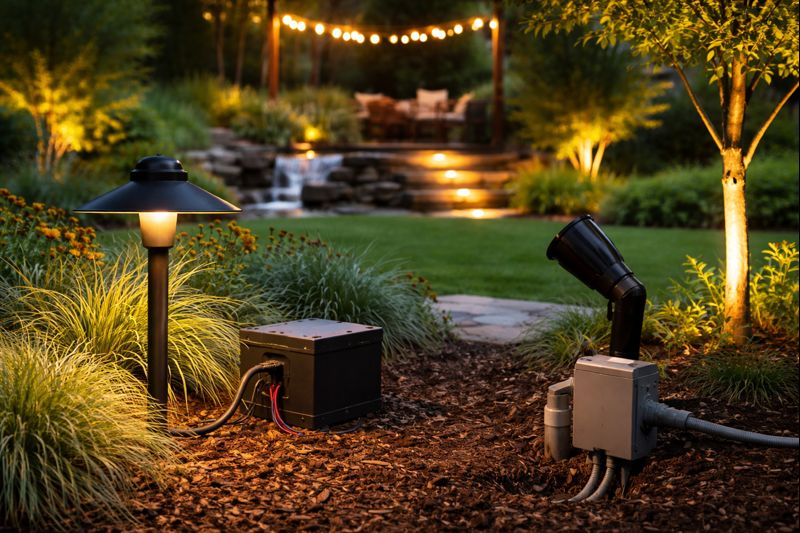
Low-voltage and line-voltage systems, two of the most commonly selected options, each offer distinct pros and cons depending on the project’s scale, lighting goals, and long-term efficiency needs. While one is valued for its flexibility, energy efficiency, intricate garden designs, and safety in residential landscapes, the other is preferred for its higher illumination output, durability, and ability to cover larger areas without voltage drop. With a clear understanding of how voltage operates in landscape lighting, homeowners and professionals can choose the system that best supports their design goals, functional requirements, and prevents installation issues. Let’s now explore the key differences in detail.
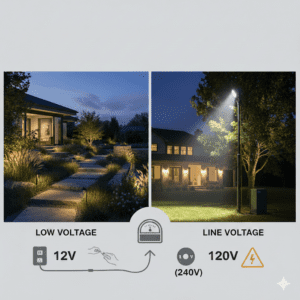
Line vs Low Voltage Comparison SnapshotLandscape lighting performance depends on whether a system uses line voltage (120V) or low voltage (12V), as each option affects electrical behavior, installation depth, safety, control systems, and regulatory requirements. Line voltage supports long distances and high-output applications but requires conduit, deeper trenching, and strict NEC compliance. Low voltage offers safer handling, easier installation, greater flexibility, and better compatibility with automation. Both systems need routine cleaning, bulb checks, weather protection, and alignment, while maintenance needs vary based on wiring depth, component sensitivity, and voltage management. |
What Is the Difference Between Line Voltage vs Low Voltage in Landscape Lighting?
Below, we have differentiated line voltage vs low voltage:
1. Electrical Behavior & Power Delivery
Line Voltage (120V) in Landscapes
Line voltage landscape lighting systems deliver full electrical power directly underground to each fixture. Because of the higher voltage:
- Electricity travels long distances with minimal loss
- Fixtures can be spaced far apart across large properties
However, high-voltage underground wiring means:
- A conduit is required to protect against moisture and soil movement
- Any damage from roots, shovels, or corrosion increases safety risk
- Outdoor junction boxes must be sealed and code-compliant under the National Electrical Code
This makes line voltage suitable only when high-output lighting is essential, such as perimeter or security lighting.
Low Voltage (12V) in Landscapes
Landscape light of Low-voltage uses a transformer to reduce power before it enters the yard, supplying a constant voltage output for stable illumination. Electricity then flows through shallow-buried cable to fixtures
In outdoor settings, this means:
- Significantly lower risk around wet soil and irrigation
- Cable can be buried just below mulch or turf
- Safer performance even if the wiring is accidentally exposed
Because power is reduced, voltage drop must be managed, but this is easily controlled through proper cable sizing and layout planning.
2. Installation in Soil, Mulch & Hardscape Areas
Line Voltage
- Requires deep trenching
- Conduits need to be installed beneath patios, walkways, & driveways
- When it comes to making adjustments to the layout, it often entails modifying
When installed, line voltage lighting is fixed and cannot be changed easily.
Low Voltage
- Shallow trenching or surface burial under mulch
- They can be relocated as plants grow and evolve.
- Well-suited to gardens with seasonal changing layouts
This makes it highly desirable in residential landscape designs.
3. Wet-Zone Application Suitability
Line Voltage
Line-voltage landscape lighting can be installed in wet or damp zones, but only under very strict electrical and safety requirements. Fixtures must be UL-listed for wet locations, use watertight conduit, and be installed with GFCI-protected circuits. Underground wiring must meet burial-depth and conduit standards, and any installation near pools, fountains, or irrigation systems is heavily restricted due to shock risk. Because of these hazards, line voltage is typically limited to hardscapes, walls, or elevated areas away from direct water exposure and usually requires a licensed electrician.
Low Voltage
Low-voltage landscape lighting is specifically preferred for wet-zone applications. The reduced voltage dramatically lowers electrocution risk, making it suitable for garden beds, walkways, water features, rain-exposed lawns, and pool perimeters (when fixtures are rated accordingly). Wiring can often be direct-burial rated, and moisture intrusion poses far less danger compared to line voltage. This makes landscape lighting of low voltage the safer, more flexible, and code-friendly option for areas with frequent water contact or high humidity.
4. Control Systems & Automation Compatibility
Line voltage system
These systems tend to work using hardwired switches or more complex electric control systems, which result in less flexible and considerably more costly automation.
Low-voltage systems
Controlling the landscape lighting voltage in modern times involves the use of automation in many cases for its convenience and benefits. Low-voltage landscape lighting works well together with timers, photocells, and intelligent landscape lighting controllers for automatic turn-off and turn-on functions based on zones.
5. Regulatory & Compliance Impact
Line voltage system
In the U.S., line voltage (120V) landscape lighting is regulated as a standard electrical installation and typically requires permits, inspections, and licensed electricians. It must comply with the National Electrical Code, including
- Article 210 (branch circuits),
- Article 300 (underground wiring),
- Article 410 (luminaires), as enforced by local .gov authorities.
Low-voltage systems
Low-voltage (12V) systems, governed by NEC Article 411, often qualify for permit exemptions in residential projects, reducing approval time and administrative requirements.
What Maintenance Considerations Exist For Line Voltage Vs Low Voltage Landscape Lighting?
Maintenance Tasks That Apply To Both Systems
These are general upkeep practices required for both line voltage Vs low-voltage landscape lighting:
- Fixture Cleaning: Regularly wipe lenses and housings to remove dirt, dust, and debris. Clean fixtures maintain brightness and prevent heat buildup.
- Bulb and Component Checks: Check the bulbs for dimming, discoloration, and flickering. Immediately replace worn-out bulbs and ensure that the sockets are clean and free from corrosion.
- Weather and Moisture Protection: Inspect the seals, gaskets, and covers of fixtures for watertight conditions. Replace any cracked or aged parts to avoid moisture intrusion.
- Alignment and Positioning: Fixtures installed outdoors may gradually shift because of wind, settling of soil, or gardening. Periodically reset to maintain proper angles and areas of lighting coverage.
Maintenance Tasks Specific To Low-Voltage Lighting
- Monitor the bulbs for flickering, reduction in brightness, or color change, then replace them accordingly.
- Check that the seals, rubber gaskets, and protective covers or caps remain watertight and protect against moisture.
- Reposition, or realign, light fixtures that could have shifted because of wind, soil movement, pets, or garden activity.
- Remove any debris, mulch, and/or leaves that are accumulated around the fixtures to ensure good air circulation.
Maintenance Tasks Specific To Line Voltage Lighting
- Check your transformer for any signs of overload and that all your wires are properly connected.
- Inspect shallow or surface-level cables for damage or exposure from soil disturbance or garden tools.
- Monitor for voltage drop, especially in longer runs; redistribute loads or upgrade wire gauge if brightness decreases.
- Tighten low-voltage connectors periodically, as they can loosen over time with environmental movement.
Conclusion
When voltage decisions are made with foresight, landscape lighting becomes a durable, controllable, and scalable solution that enhances outdoor spaces for years rather than a short-term installation that demands constant correction. Making those decisions correctly requires hands-on experience with real landscapes, not just theoretical lighting layouts. TridentPro Lighting delivers that expertise through a fully integrated approach, supplying high-quality landscape lighting fixtures and managing voltage planning, and installation execution. This ensures every system is built to perform consistently from day one and continue operating reliably without unnecessary adjustments. So contact us today to take the service!
Frequently Asked Questions
What are the installation requirements for low-voltage vs. line-voltage landscape lighting?
For low-voltage lighting, the need is for a transformer, waterproof cables, tight wire, and location, while high voltage landscape lighting will require the use of conduit, junction boxes, GCFIs, and only licensed electricians should perform the work.
How far can you extend low-voltage lighting wires without a voltage drop?
The maximum length of low-voltage lighting wire you can run without seeing a significant voltage drop is determined by three factors: the size of your wire (gauge), the total wattage load on that wire, and the size of your transformer. Typically, with a 12-gauge wire you can run up to 100-150 ft., while with a 14-gauge wire you can only run shorter distances. Using multiple runs, keeping the loads balanced, and using higher-quality LED fixtures can help to reduce the amount of voltage lost through the wire.
Are low-voltage outdoor lights appropriate for larger properties?
Low-voltage landscape lighting may be employed on large properties, provided it is well planned. The application of multiple transformers, multi-tap transformers, large-gauge wires, and short pieces may allow maximum brilliance and postpone the consequences of any probable voltage drop. LEDs, on the other hand, improve efficiency, rendering low-voltage landscape lighting perfect for large landscaping projects dealing with safe installations.
What about intermixing low-voltage lights with line-voltage lights in the same outdoor area?
Line vs low-voltage lighting can be mixed in the same yard, as long as they are on different circuits. They both need different electrical wiring and transformers. Where safety is a major aspect, it is advised that low-voltage lighting be used, especially along pathways and as accent lighting. Line voltage is suited for large areas that need powerful lighting.