

Lighting might seem simple at first glance, but the right lighting setup can easily convert any space from average to exceptional. Among the many technical factors that shape lighting arrangement, beam angle stands out as one of the most influential. The beam angle controls how wide or narrow the light spreads from a fixture, directly influencing how a room looks and feels. Choose the wrong beam angle, and you risk creating a space that feels overly harsh with sharp hotspots and dark corners, or one that’s too flat and dim, lacking contrast and character.
This guide is all about beam angles—from what they are, to how they influence lighting design, and the key considerations when choosing the right one for your project.
Beam Angle Lighting Summary OverviewBeam angle determines how widely or narrowly light spreads, influencing brightness, focus, and visual comfort. Narrow 10°–25° beams create precise accents, medium 25°–40° beams support task lighting, while wide 40°–120° beams provide broad ambient illumination. Selecting the right angle depends on room size, ceiling height, lighting purpose, fixture spacing, bulb type, and surface reflectivity. Beam spread calculations, adjustable optics, and strategic fixture placement further improve lighting accuracy and flexibility. |
What Is a Beam Angle?
The beam angle of a light source describes the spread of light emitted from the fixture. Measured in degrees, it defines the angle between two points on either side of the bulb’s center where light intensity drops to 50% of its maximum brightness. This determines how concentrated or wide the illumination will be on a surface.
Why does this matter? The beam angle directly influences the distribution of light in a space. A narrow beam angle creates a tighter, focused spot, while a wide beam angle washes a larger area with softer light. For anyone planning a lighting project, knowing how beam angles work is fundamental to creating effective illumination. For more on how directional lighting affects design, read Asymmetric Lighting Vs Symmetric Lighting: Things You Need to Know.
Common Beam Angles & Their Uses
Beam angles are broadly categorized into three types, each with distinct applications. The choice depends on your lighting plans and the specific needs of your space.
1. Spot (Narrow) Beams (10°–25°)
Spot beams feature a narrow beam angle, typically between 10° and 25°, which produces a highly concentrated light that focuses precisely on small areas. With high center beam candle power (CBCP), they deliver intense brightness at the target with minimal light spill, ideal for creating dramatic focal points. Spot beams are typically formed using TIR lenses or precision reflectors to achieve crisp beam edges and sharp definition. The beam diameter varies with distance, with longer throws creating tighter spots. Spot beams excel at highlighting artwork, architectural features, or key design elements, but they are not intended for general ambient lighting.
2. Medium Beams (25°–40°)
Medium lighting beam angles, ranging from 25° to 40°, are designed to balance focus and spread. They deliver a concentrated yet broader light compared to narrow spots, making them ideal for task lighting where both clarity and coverage are needed. With moderate center beam candlepower (CBCP), medium beams effectively brighten work surfaces without excessive spill. Achieved through reflectors or TIR optics, they maintain a comfortable light distribution ideal for kitchens, reading nooks, and workspaces.
3. Wide Beams (40°–120°)
With covering angles between 40° and 120°, wide beams—such as those used in 45-degree lighting—are optimized for broad, uniform illumination. They produce a lower CBCP but provide widespread coverage, ideal for ambient lighting in large or open spaces. Wide beams use diffusers, frosted optics, or wide-angle reflectors to soften light and minimize harshness. As the beam widens, intensity lowers, but lux distribution across surfaces improves significantly. These beams are typically found in LED panels, floodlights, and large-area downlights, lighting living rooms, hallways, commercial spaces, and outdoor areas.
Beam angles decide how your space truly shines.
Visual Guide to Beam Angle and Light Spread
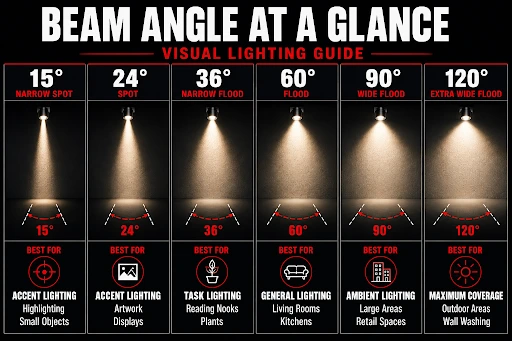
Beam angle determines how widely or narrowly a light source distributes illumination across a space. Narrow beam angles create concentrated, intense light, making them ideal for highlighting specific objects, architectural features, or display areas. Wider beam angles spread light over a larger area, providing softer and more uniform illumination for general lighting. Choosing the right beam angle depends on the fixture’s purpose, mounting height, room size, and desired lighting effect. The infographic below visually compares these differences to help you select the appropriate beam spread.
Factors to Consider When Choosing a Beam Angle
Room Size and Ceiling Height
- Small rooms or low ceilings generally benefit from wider beams to avoid creating overly harsh or intense spots.
- Large spaces or high ceilings may need narrower beams to ensure sufficient brightness reaches the desired area.
Purpose of the Lighting
- Task lighting: Go with medium beams for workspaces, desks, or kitchen surfaces to concentrate light effectively.
- Accent lighting: Opt for a narrow beam to call attention to a feature or object.
- General (ambient) lighting: Wide beams work best for general illumination in living rooms, hallways, and shared spaces.
Fixture Placement and Spacing
- Multiple narrow-beam lights can cover a long table or corridor without unwanted spill.
- Overlapping wide beams can create seamless light in open areas.
Type of Fixture and Bulb
Not all fixtures are designed to work with every beam angle. Always check the manufacturer’s specifications for the recommended beam angle for the fixture you’re using. Additionally, the type of bulb you choose (LED, halogen, incandescent) can affect the quality and spread of light. LEDs tend to offer more focused, energy-efficient beams, while halogen bulbs may produce warmer, more diffuse lighting. Make sure the bulb matches the fixture’s intended purpose to optimize the lighting effects.
Surface Reflectivity
- Highly Reflective Surfaces: Rooms with white walls, mirrors, or glossy floors can intensify the light’s spread, making a wide beam angle even more effective. This reflection helps to bounce light around the room, improving brightness without the need for additional fixtures.
- Dark or Absorbent Surfaces: In rooms with dark walls, floors, or furniture, light is absorbed rather than reflected. In this case, using narrower beams or more intense light sources may be necessary to ensure the space is adequately lit. Stronger or more focused light can counteract the absorption and provide the needed illumination.
How to Measure and Adjust Beam Angles
Manufacturers usually list the beam angle on packaging or technical datasheets, but it’s valuable to know how these measurements translate in the real world. To make this easier, many professionals refer to an LED beam angle chart, which provides a visual reference of how beam angles affect light spread at various distances. These charts are especially helpful when planning layouts or choosing between fixtures with different spreads.
Measuring the Beam Spread
You can estimate the coverage of a given beam angle with a simple formula:
Beam Spread (in feet) = Distance from light (in feet) × Tangent (beam angle/2)
For example, a light with a 30° beam angle installed 10 feet above the floor:
- Tangent (30°/2) = tan 15° ≈ 0.2679
- Beam spread = 10 × 0.2679 ≈ 2.7 feet
This calculation lets you predict how much of the floor or wall will be illuminated.
Adjusting Beam Angles
Some modern fixtures, especially those with adjustable lenses or reflectors, can modify the beam angle. These are especially handy in galleries, stage lighting, or commercial settings where flexibility is key.
If you’re using fixed-beam fixtures, adjust the lighting design by changing fixture placement or using multiple lights to achieve your desired effect.
Composing the Perfect Lighting Scheme
Selecting the right light beam angle may initially seem complicated. Still, with the right approach, it becomes an easy and impactful decision that illuminates the look and feel of any space. For an advanced approach, reach out to us at TridentPro Lighting. We offer customized lighting solutions, specializing in everything from residential upgrades to large-scale commercial projects. Trident Pro Lighting combines expert advice, high-quality products, and digital modeling tools to help you visualize and perfect your lighting plan before installation.
Precision lighting starts with the right beam angle.
Frequently Asked Questions About Beam Angles in Lighting
Does beam angle affect the brightness of a light?
Yes. Beam angle influences how concentrated the light appears. A narrower beam generally produces higher intensity at the center, while wider beams distribute light across larger areas.
What happens if two lights have the same lumens but different beam angles?
They can appear very different. The narrower beam concentrates more light into a smaller area, while the wider beam spreads the same output over greater coverage.
Can I change the beam angle of an existing LED light?
Only if the fixture supports interchangeable optics, lenses, or reflectors. Fixed-optic fixtures generally require replacement rather than adjustment to achieve another beam spread.
Does beam angle change how many lights I need?
Potentially. A fixture’s beam spread affects coverage, so changing optics may alter spacing requirements. The final quantity should also account for lumen output, mounting height, and target illuminance.
Can the same beam angle work for both indoor and outdoor lighting?
Yes, but the application requirements differ. Outdoor projects may also require suitable IP ratings, glare control, mounting considerations, and optics designed for environmental conditions.