

Ever feel like your outdoor lights are doing the bare minimum, just kind of… there? You’re definitely not alone. Traditional outdoor lighting often falls flat, with bland illumination and outdated designs that make it hard to get creative. But that’s starting to change. More and more homeowners are rethinking how they light up their patios, gardens, and backyards. Leading the way in this shift are RGB LED lights, bringing a whole new level of personality to outdoor spaces with endless color options, energy efficiency, and a design-forward feel that actually makes a difference.
Unlike old-school fixtures, these are modern LED bulbs that change color while offering waterproof casings, long-lasting durability, and reliable wireless connectivity. This means they can handle the weather, stay connected to your smart systems, and work wherever you need them, making them incredibly versatile whether you’re lighting up a small patio or a full backyard entertainment space.
Let’s take a closer look at how these lights work and why they’re reshaping the way homeowners think about outdoor lighting.
RGB Lighting: Color, Control, and CustomizationRGB LED technology blends red, green, and blue diodes to produce over 16 million colors, using pulse-width modulation and smart controllers for seamless transitions. Outdoor applications range from architectural highlighting and landscape accents to pool lighting and zoned patio setups, each customizable through smart ecosystems and programmable scenes. Weatherproof, energy-efficient, and adaptable to any occasion, these systems transform static outdoor spaces into dynamic environments, boosting curb appeal, functionality, and everyday ambiance for homeowners. |
What Are RGB LEDs? Understanding The Science Behind Dynamic Color Changing
RGB LEDs work by combining red, green, and blue light chips into one unit. Each of these diodes emits light at specific wavelengths: red around 620–750 nm, green around 495–570 nm, and blue around 450–495 nm. By adjusting the brightness of these colors separately, outdoor RGB lights can create over 16 million different shades.
To understand it better, let’s break down the science behind this dynamic color changing:
Additive Color Mixing
It all comes down to how we perceive light and how colors are made using electrical currents. RGB LEDs create color through additive color mixing, which means blending different intensities of red, green, and blue light can produce a huge range of colors.
Pulse-Width Modulation (PWM)
To control how bright these colors appear, LEDs use pulse-width modulation (PWM) by rapidly switching power on and off to adjust brightness. To eliminate visible flicker, modern controllers adhere to standard guidelines set by the Institute of Electrical and Electronics Engineers (IEEE) in their IEEE Std 1789-2015 recommended practices, ensuring smooth, eye-safe, and precise color channel control.
Controllers and Software
What makes those dynamic color shifts possible are advanced controllers and software. These systems manage real-time changes to the LEDs, adjusting both color and brightness based on input. Many modern systems now rely on protocols like SPI or the increasingly common DMX and Bluetooth Mesh for outdoor installations to handle all that data quickly and accurately.
Curious how it all comes together? See the Symphony Controller that brings every color-changing scene to life.
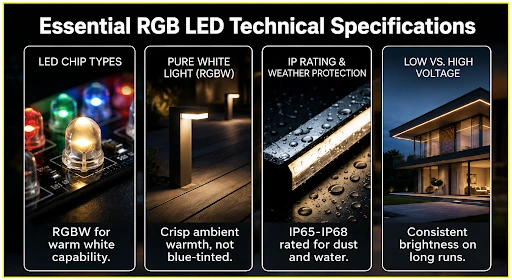
Essential RGB LED Technical Specifications
Choosing the right dynamic lighting balances performance and durability. While RGB chips mix red, green, and blue diodes for vivid colors, upgrading to RGBW adds a dedicated white diode for clear, natural ambient light without artificial blue undertones. For long-term weather resistance, the International Electrotechnical Commission (IEC) outlines moisture and dust protection criteria in its IEC 60529 Ingress Protection standard, requiring ratings from IP65 to IP68. Additionally, choosing 24V systems over 12V prevents voltage drop along longer outdoor runs.
How Dynamic Color-Changing Lights Redefine Outdoor Space?
One Fixture, Infinite Looks
With dynamic RGB LED lights, one fixture can turn into a thousand different looks. This means that you can choose from a wide range of colors to set the perfect mood, i.e., whether it’s a soothing blue for a relaxing night or a bold red for a lively gathering. Additionally, changing between different colors and preset scenes is quick and easy, so your outdoor space can instantly match any occasion.
Adaptive Lighting Design
Unlike traditional bulbs for outdoor lighting that offer a fixed brightness and color, adaptive lighting systems let you adjust color, intensity, and mood in real time based on things like activity, time of day, or your preferred lighting scene. You can highlight architectural features, accentuate landscaping, or make your outdoor furniture pop, all while reflecting your style. And the best part? You can even program them to remember your favorite settings for different occasions.
Experience Creation
Dynamic RGB LED color-changing lights create an experience for your outdoor space. Some systems can also sync color changes with music, adjusting them to the beats and rhythm of the tunes. For an even more immersive feel, programmable color transitions and lighting effects can create a more engaging atmosphere for outdoor gatherings. This means the lights don’t just sit there; they can change with the way you use the space, making every outdoor moment feel special.
Integration with Smart Ecosystems and Automation
These lights can be integrated with smart sensors to adjust to changes in natural light automatically. Imagine the lights gradually shifting from a bright, midday white to a gentle, evening blue without needing to adjust them manually. With smart home systems, you can also create preset lighting scenarios, such as dimming lights at sunset or turning them on as you approach the door. Depending on the system, you can also control colors, brightness, schedules, and scenes through a smartphone app or compatible smart-home platform.
Zoned Lighting and Programmable Scenes
The modular control of RGB LED lights allows you to divide outdoor lighting into zones, giving different areas their own colors, brightness levels, or scenes. This can be useful for patios, pathways, landscaping, and architectural features, allowing you to adjust each area without changing the entire lighting setup.
Ready for lighting that stays stunning all year long? Explore permanent options built to last.
Applications Of RGB LED Lighting In Outdoor Spaces
Have a look at the following applications of RGB LED lighting in outdoor spaces:
- Architectural Highlighting: RGB LEDs let you change colors easily to highlight features like columns, arches, or textured walls, creating different lighting effects.
- Landscape Accent Lighting: In gardens and parks, these outdoor color-changing LED lights highlight trees, shrubs, statues, or water features with customizable hues.
- Pathway and Step Illumination With Mood Control: RGB LED strip lights or in-ground fixtures are often used along walkways, decks, and steps for safety and to create a smooth, appealing look.
- Pool and Water Feature Lighting: Underwater RGB LEDs in pools, fountains, and ponds create a lovely visual display with seamless color transitions at night. They’re IP68-rated and often work with DMX systems, and increasingly Bluetooth- or Wi-Fi-based controllers, for synced lighting effects.
- Festive and Seasonal Decor Integration: Many homeowners and cities now use permanent RGB LED track lights on eaves and gutters, saving setup time with pre-programmed color sequences.
- Smart Patio & Deck Lighting in Residential Spaces: Homeowners add these outdoor LED lights that change color to patio covers, railings, or pergolas for easy mood changes, a simple upgrade that also contributes to how outdoor lighting adds value to your home by boosting curb appeal and everyday usability.
- Emergency or Alert-Based Color Coding: In industrial outdoor places, RGB LED towers often flash different colors to signal various safety conditions.
Conclusion
RGB LED lighting gives outdoor spaces room to evolve with changing needs, occasions, and design preferences. With the right system, color, brightness, and lighting scenes can work together to create a more intentional outdoor environment. TridentPro Lighting can help bring that vision together with custom outdoor lighting solutions, RGB systems, smart controls, and professional installation designed around your space.
Your backyard doesn’t need one mood all year. Let TridentPro Lighting build lighting that keeps up!
Frequently Asked Questions: RGB LED Zones, Controllers & Installations
Can different zones of RGB LED lighting run different colors at the same time?
Yes, zoned systems let you assign unique colors, brightness, or scenes to specific areas like a patio versus pathway, so each zone operates independently within one setup.
Is a dedicated controller necessary, or can smart bulbs work independently?
Standalone smart bulbs can operate individually, but a dedicated controller like TridentPro’s Symphony Controller allows synchronized scenes, zoning, and more precise coordination across an entire property.
Can RGB LED lighting be programmed to change automatically for holidays or events?
Many systems support pre-programmed color sequences that can be scheduled in advance, allowing lighting to automatically shift for holidays, parties, or seasonal themes without manual adjustment.
What’s the difference between permanent and temporary RGB LED lighting installations?
Permanent installations are professionally mounted for year-round use with weatherproof housing, while temporary setups use modular, repositionable fixtures ideal for one-time events or seasonal displays.
Can RGB LED lighting be synced across multiple areas of a large property?
Yes, advanced controllers can coordinate lighting across separate zones or structures simultaneously, keeping colors, transitions, and scenes consistent even across larger residential or commercial properties.